.jpeg)
Pull straps: an underestimated tool in the world of assistance dogs
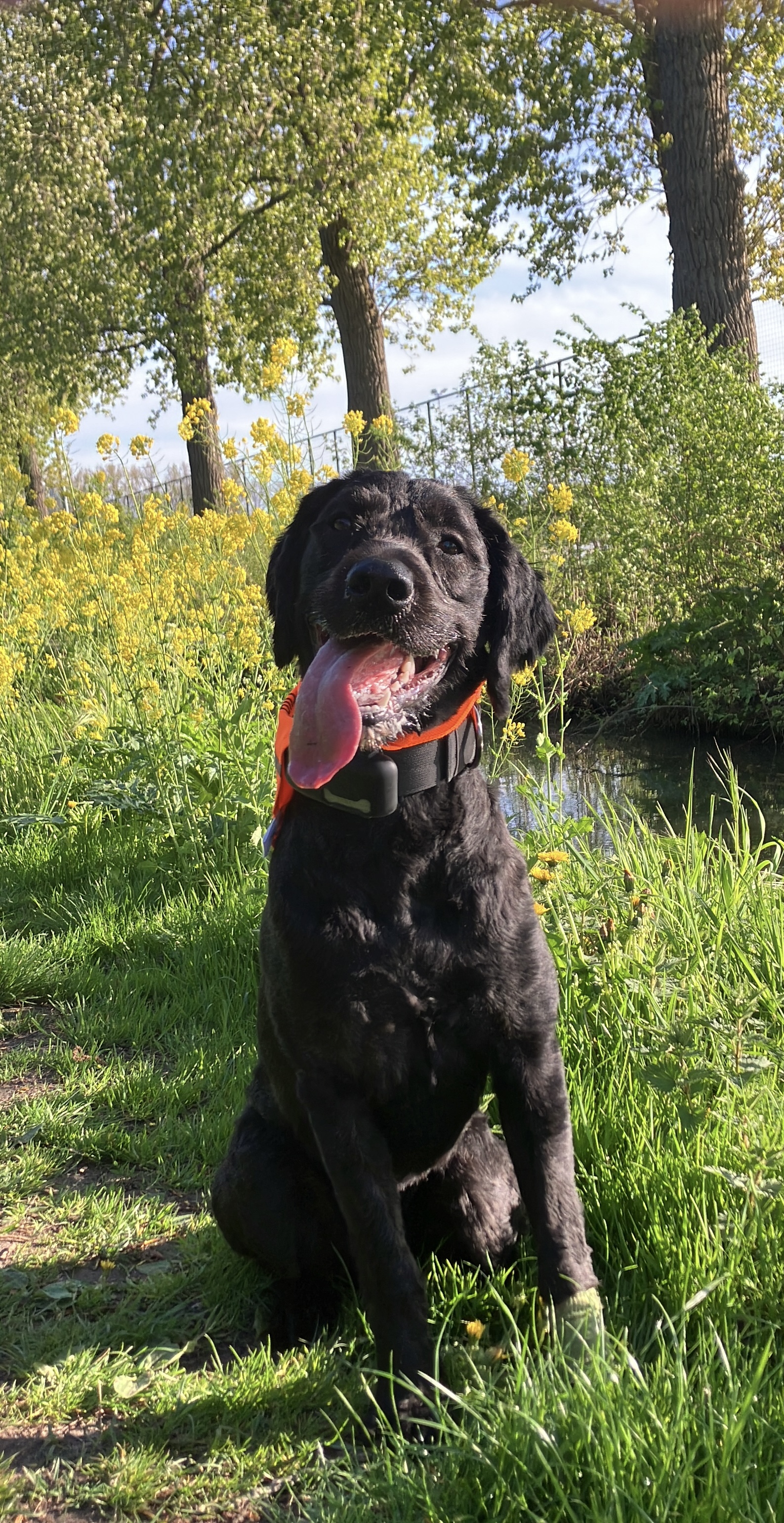
When people see an assistance dog with a pull strap, they often think that the dog is pulling the user along. That is perhaps one of the biggest misconceptions about this aid.
A pull strap is, in fact, much more than a bond between human and dog. It is a means of communication. An aid that allows the user to better feel the movements, direction, and subtle signals of the dog. Depending on the specific needs, a pull strap can be used in very different ways.
However, the versatility of a pull strap is often underestimated.
No standard solution
Just as no two assistance dog teams are the same, there is no pull strap that is the right choice for everyone.
The way a pull strap is used depends on the disability or support needs, the tasks of the assistance dog, the physique of the dog and user, and the personal preference of the team.
While some primarily need a lightweight and compact pull strap, others opt for an ergonomic handle or a fully adjustable version. Therefore, there are various types of pull straps, each with its own features and applications.
Therefore, there is no single perfect pull strap.
There is only a pull strap that fits the team.
What can a pull strap be used for?
Depending on the training of the assistance dog and the needs of the user, a pull strap can be used for, among other things:
light forward guidance (Forward Momentum);
orientation and navigation to learned locations;
better feeling the dog's movements;
body contact and grounding;
support for autism;
support with PTSD and other mental health-related requests for assistance;
dizziness or balance problems;
night blindness or impaired vision;
neurological or physical conditions where extra orientation or feedback is desirable.
It is important to know that the pull strap itself does not do the work.
The assistance dog performs the task.
The pull strap helps the user better perceive the dog's movements, direction, and signals. It is precisely this subtle communication that can make a big difference for some teams.
One tool, different situations
Even within a single assistance dog team, needs can vary.
You might use a different pull strap at home than when you go shopping for the day. When traveling, a compact version is convenient because it takes up little space. During longer walks, however, an ergonomic handle might be more comfortable. And as a dog grows, gets a different brace, or learns new tasks, the ideal adjustment can also change.
Therefore, many teams choose to use multiple types of pull straps, depending on the situation.
Safety always comes first
A pull strap is not a tool you can simply lean on, or with which every dog can provide forward guidance.
The use of a pull strap must always be consistent with the assistance dog's training, the dog's load capacity, and the user's needs. The dog's well-being always comes first.
Well-fitting equipment and correct adjustment are essential for comfortable and safe collaboration.
What does science say?
Remarkably, very little scientific research has been conducted into the use of pull straps on assistance dogs.
Most studies focus on the influence of different harnesses on dog movement and the well-being of working dogs. Researchers themselves indicate that there is still a significant lack of knowledge. There are also indications that the stride length and shoulder movement of dogs may change depending on the type of harness and how it is used. At the same time, researchers emphasize that there is still insufficient long-term research available to draw firm conclusions regarding the consequences for the health of working dogs.
Specific research into the use of pull straps for, for example, Forward Momentum, autism, PTSD, mental health-related issues, dizziness, or night blindness is currently virtually unavailable.
However, that does not mean that these applications have no value.
On the contrary.
In the practice of assistance dog users, trainers, occupational therapists, and other healthcare professionals, it is seen daily how much difference a well-tuned pull strap can make for individual teams.
In this regard, practice is currently ahead of science.
Precisely for this reason, more independent scientific research into pull straps and mobility aids for assistance dogs would make a valuable contribution. Not only to better substantiate practical experiences, but also to further develop aids and further improve the well-being of both the dog and the user.

Why different types of pull straps exist
I regularly get asked why there are multiple types of pull straps available in the webshop.
The answer is actually very simple.
Because no two assistance dog teams are the same.
One person is looking for a lightweight, simple pull strap that is easy to carry. Another needs an ergonomic handle that fits comfortably during longer distances. Yet another wants plenty of adjustment options, so that the length, position, and angle can be precisely tailored to the user, the dog, and the harness used.
That is why I do not believe in one universal solution.
I believe in tools that align with the needs of the individual team.
Finally
An assistance dog is custom-made.
The tools used for this are too.
A well-chosen pull strap can make the partnership between dog and user more comfortable, improve communication, and ensure that the dog can perform its tasks optimally.
Perhaps that is why a pull strap is one of the most underestimated tools in the world of assistance dogs.
Not because every assistance dog needs one.
But because a well-fitting pull strap can make a world of difference for the teams that use it.
Sources
Williams E, Hunton V, Boyd J, Carter A. Effect of harness design on the biomechanics of domestic dogs (Canis lupus familiaris). Journal of Applied Animal Welfare Science (2023).
Knights H, Williams J. The influence of three working harnesses on thoracic limb kinematics and stride length at walk in assistance dogs. Journal of Veterinary Behavior (2021).
Lafuente MP, Provis L, Schmalz EA. A Systematic Review of the Biomechanical Effects of Harness and Head-Collar Use in Dogs. Systematic literature review.
Tremblay-Lemay R, et al. Effects of a trained mobility assistance dog on upper extremity muscular effort during wheelchair propulsion in individuals with a spinal cord injury. Clinical Biomechanics (2020).


Comments