.jpeg)
Not a Robot, Not a Toy – On Intelligent Dogs, Self-Regulation, Energy and Being Honest
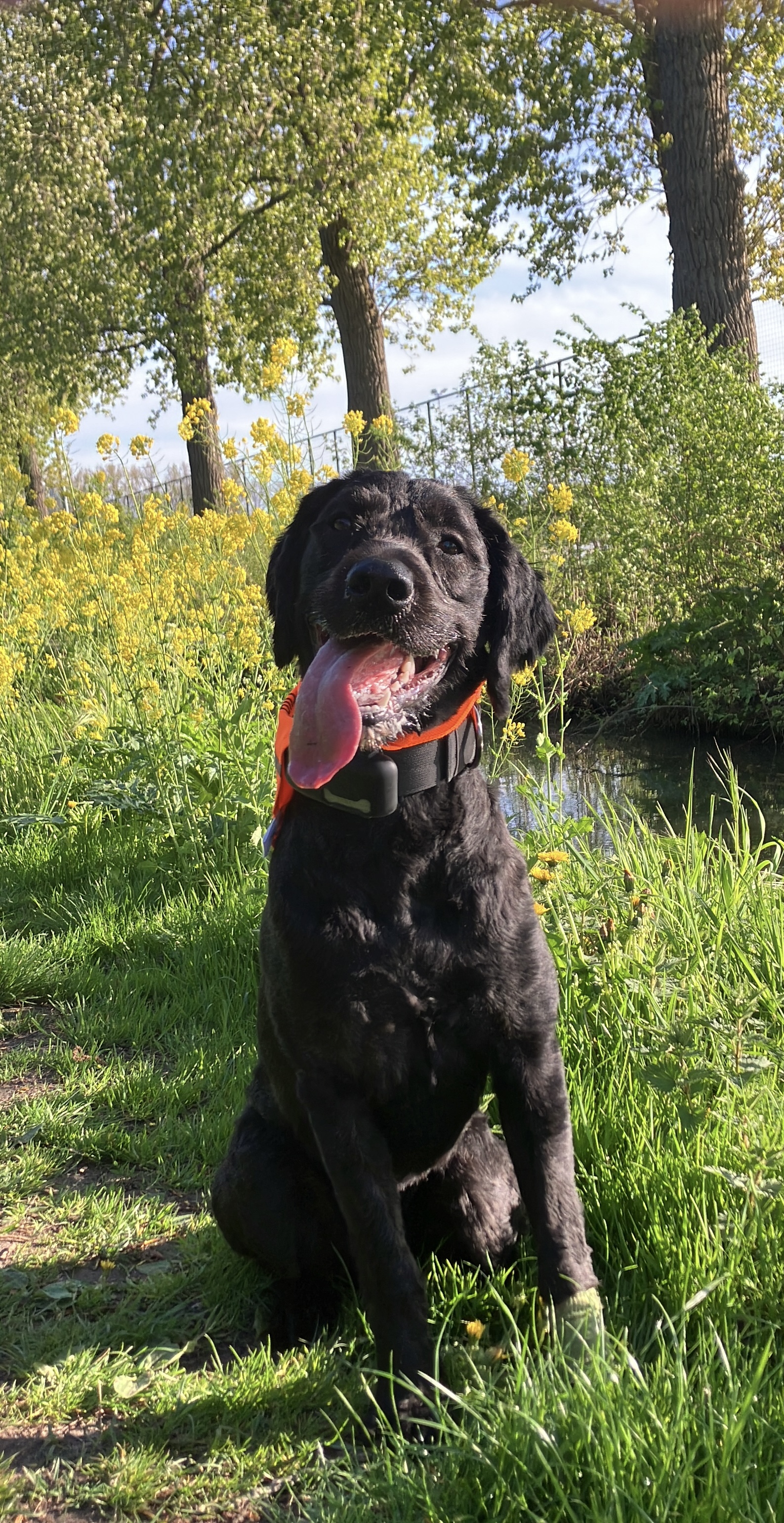
About self-regulation, mental load, triggers and why honest observation matters more than perfect obedience
I often say that I didn’t want a “slow lab”. And let me explain that properly, because I am not talking about Labradors as a breed. Years ago, I had a dog I always called my “slow lab”: a family dog, kind, reliable, easy. Truly a sweetheart. But also a dog who was not very independent, did not really think along, and mostly just followed.
He was a lovely dog. And for his role as a family pet, he was perfect. But he was not the type of dog I wanted again.
My next two dogs were very clearly self-thinking dogs. And Iris is too. That is no coincidence. That is a conscious choice. I love dogs with active minds. Dogs who think along, solve problems and take initiative. That sometimes makes life more complicated — but also much richer.
I did not want a robot. I wanted a thinking partner.
---
Being smart is not a switch
Iris is smart. Truly smart.
She can open doors, remember routes, remember where food was (and still know it hours later), make plans and wait for the right moment. If she has seen fresh meat or chips somewhere, she remembers it. And she will still remember it later. And if she gets the chance — because a door is open or because she can open one herself — she will calmly walk to the other side of the area to go and get it.
Not impulsively.
Not chaotically.
But purposefully.
That is not “naughty behaviour”. That is memory, motivation and problem-solving ability.
And yes — that also means that her clever brain sometimes comes up with ideas of its own.
That is not a bug. That is exactly the feature.
---
Self-regulation is not all-or-nothing
Iris can ignore almost everything outside: other dogs, food, all kinds of stimuli. But certain types of meat, fresh meat and chips are extreme high-value triggers for her.
She can still control herself when I clearly tell her she is not allowed to take it, especially if she knows she will get a different reward later. But the motivation does not disappear. She remembers where it is. And if a chance appears later, she will still carry out the plan.
That does not mean she has no self-regulation. It means: self-regulation is actively suppressing a strong motivation. And that costs energy. And that energy is not unlimited.
---
And it is also trigger-dependent
With “normal” food she can regulate herself so strongly that sometimes she simply does not eat at all. Everything is so focused on control and restraint that even eating does not get through anymore.
But with certain types of food, that restraint is much harder to maintain.
That is not a training failure. That is how the brain works. Some stimuli are neurologically simply “top priority”.
---
The battery can run empty
Self-regulation costs mental energy. After a day full of stimuli, other dogs, tension or responsibility, that battery can simply be empty.
And then you see: she can suddenly no longer regulate herself properly in any situation, everything hits harder, or she discharges that tension on other things.
Not because she is being difficult. But because the braking system is empty.
---
That is why management is sometimes more important than training
When I know Iris has spotted something, I also know: front door locked, inside door closed, first walk past that place together again, check that it is gone, only then “free” in the house again.
Not because she is unreliable. But because I know: her brain has stored that goal.
In the behaviour world this is called: “Set your dog up for success.”
Not hoping that it will go well. But arranging the environment so that she cannot fail.
---
And yes… living next to a snack bar does not help
That means: constant smell of fried food, food on the street, high-value triggers in the environment. For a dog, that is not a neutral environment — it is a permanent high-value stimulus zone.
Even a dog with good self-regulation has to restrain herself much more often and for much longer there. And because self-regulation costs energy, that simply means the risk of a “leak” in that restraint becomes bigger if you let management slip.
Not every dog can always regulate itself
Not every dog can regulate itself equally well. And even dogs who usually can, may suddenly not be able to when they are stressed, tired, overstimulated or faced with very strong triggers.
Self-regulation is context-dependent, energy-dependent and trigger-dependent. That is not a character flaw. That is neurology.
And some dogs cannot (yet) do it at all. They do not need stricter rules, but more guidance, more safety and more external structure.
---
We cannot always see what is going on inside our dog
We cannot feel what our dog feels. Just like nobody can see when you have a headache.
What was not a problem yesterday can suddenly be too much today. Not because someone did something wrong, but because the capacity is different today.
We are not dogs. We are not inside that body. Sometimes you only see it when it is already happening.
That is not failure. That is the reality of living with another nervous system.
---
“My dog would never do that” does not exist
I do not believe in “My dog would never do that”.
Behaviour is not a fixed trait. It is a snapshot of a nervous system under load.
---
Why I consciously choose this
I consciously chose this. I did not want an easy, purely compliant dog. I wanted a thinking partner.
That means: more management, more anticipating, more adapting — and sometimes extra locks on the doors.
But it also means: a dog who can assess, solve, think along and function in real life.
Not a robot, not a toy, not a machine
A dog is not a robot. Not a toy. And not a machine we have full control over. It is a living being.
With its own nervous system, its own inner world and its own limits.
We can guide, train and manage. But we will never have full control.
And that is not a weakness. That is respect for life.
---
Finally
Everyone wants their dog to behave well. And almost everyone has good intentions. But it is important to stay honest.
Behaviour is not a guarantee.
Self-regulation is not an unlimited resource.
And dogs are not machines.
We live and work with living beings. And that does not call for a fantasy of control, but for respect, honesty and responsibility.
And honestly? I would not trade her for a “slow lab” for anything.

Comments