.jpeg)
Moving with an assistance dog: what no one tells you (and how you really help your dog)
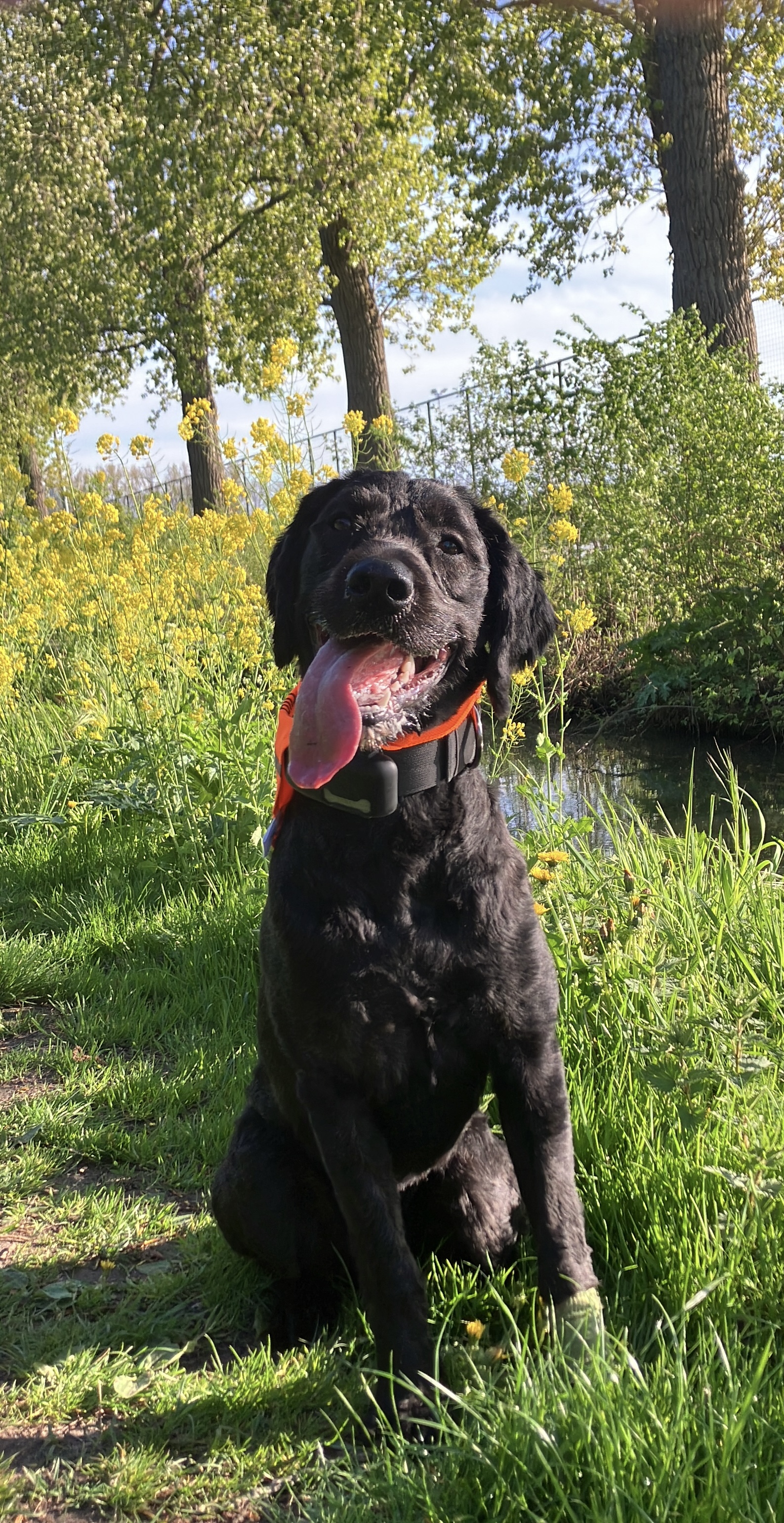
Moving with an assistance dog sounds quite simple on paper. Pack boxes, move belongings, new house, take the dog along — done.
But in practice, things are really different.
Over the past few weeks, I have experienced firsthand the impact a move has. Not only on me, but especially on Iris. And what struck me most is that it is not just about behavior… but above all about her ability to work.
For it is precisely during a period full of chaos that you need your assistance dog the most — while at the same time that is the moment when you can actually ask the least of him.
And that contrast determines everything.
What really happens during a move
I moved in phases.
That meant that I had a period in which:
my things were distributed
I stayed in multiple places
and Iris no longer had a stable base
Old house, new house, and occasionally at my parents'.
For a dog, that means one thing: unpredictability.
And you noticed that immediately.
Stress starts sooner than you think
The stress doesn't start on moving day.
That starts with the very first box.
With Iris I saw:
unrest
tension
continuously seeking contact
and finally drive
For her, that driving is not “hyperactive behavior,” but a signal that she has already crossed her limit.
And that makes it complicated.
Because you can't stop moving.
Chaos is inevitable. But how you deal with it is not.
Stress amplifies what is already there
What I also noticed is that her weaker points came to the fore again.
Iris has been bitten multiple times. As a result, she is not always relaxed around other dogs. That, however, actually went better.
Until the move.
Then you saw:
faster tension
a big mouth on the line
listen less
pull more
Not extreme. But clear.
Stress doesn't change a dog—it amplifies what is already there.
Work stops when the basics fall away
Perhaps the most important:
Iris largely stopped working.
You saw:
less focus
tasks that became sloppier
tasks that were eliminated
a dog that was mainly preoccupied with her own tension
And that is exactly the moment when you need her the most.
But:
An overloaded assistance dog cannot work reliably.
So my choice became:
fewer questions
stop earlier
sometimes expect absolutely nothing
Not because she can't do it. But because she shouldn't have to at that moment.
Deliberately asking fewer questions to protect training
A very important choice for me was that at a certain point I consciously stopped asking her things .
Not because she can't do it. But because you saw that she was getting sloppy.
Tasks that are normally performed neatly and carefully became:
half executed
rushed
or just not good enough
And that is a risk.
Because an assistance dog in training also learns during these kinds of periods.
And if you keep asking while your dog is actually overloaded, something happens that you don't want:
You confirm sloppy work
You build in bad habits
and you undermine your own training
So my choice was very deliberate:
👉 better to temporarily ask fewer questions 👉 than to teach the wrong things that you have to correct later
That is sometimes difficult.
Because you know that your dog can normally do it. And you need her too.
But:
Training is not only what you teach—but also what you prevent from being taught incorrectly.
By taking a step back in time:
maintained the quality of her work
she was given space to recover
and she was able to neatly pick up where she left off later.
Maintain structure where possible
What I have done very consciously is precisely not to change things.
I held:
her evening ritual the same
her walking times the same
her moments of rest the same
Regardless of how the day went.
Sometimes that meant my schedule had to take a back seat.
But that gave her something to hold on to.
💡 For a dog, predictability is not a luxury. It is safety.
A sense of security is also found in scent
In addition to texture, scent played a huge role.
Her little dress from the old house went everywhere with her.
Not washed. Not tidy. But familiar.
That became her place.
In addition, I have deliberately used scent.
I worked with a scent carrier on her collar in combination with a pheromone spray. For example, with the scent buddy — into which you can add a scent that your dog knows.
That provided just that little bit of extra peace of mind during peak moments.
💡 Scent is one of the strongest forms of recognition for a dog.
Sensory regulation: more than just behavior
In addition to scent, I also used a Relaxopet .
Especially at times when:
there were many people
there was a lot of movement
or the tension rose
That helped her settle down faster at rest.
But one thing is important here:
She has known this since she was a puppy.
I didn't introduce anything new during the move.
💡 Adding new stimuli during stress often backfires. Familiar tools can actually provide support.
Clarity works better than freedom.
Which might feel contradictory:
I gave her less freedom.
Don't let them go along with everything. Don't involve them in everything.
But:
a place of one's own
delimited space
I have a clear view of myself
And that brought peace.
Freedom in chaos creates unrest. Clarity brings relaxation.
Your stress plays a role too.
What is often forgotten:
You are changing too.
More stress. More stimuli. More pressure.
And your dog notices that.
An assistance dog does not work independently of you. They react to your tension and behavior.
So besides the environment… your taxes come on top of that.
The mismatch no one is talking about
And then you get to the hardest part.
You need your dog the most…at the moment when he can give the least.
That clashes.
And if you don't handle that consciously, you will start asking more... while your dog can handle less.
That is where things often go wrong.
Recovery happens in steps
What I thought was very beautiful to see:
Recovery will come naturally. But not all at once.
For Iris, that starts with:👉 bringing medication
That is her starting point.
Then:
small tasks
help around the house
increasing focus
Until she is back up to her level.
Don't force. Don't push. But give space.
Conclusion
Moving with an assistance dog is not a practical task.
It is a process of alignment.
To your dog. To yourself. And to what is feasible.
Sometimes that means asking fewer questions. Sometimes that means letting go.
But ultimately, it mainly means:
Working together — even when things don't go perfectly.


Comments