.jpeg)
Friendly guidance for assistance dog handlers on answering public questions without sharing medical details, while protecting privacy and access.
Updated: Jan 28

About assistance dogs, curiosity, and guiding conversations
Anyone who goes out with an assistance dog knows one thing for sure:you are never completely invisible.
People look. People ask questions.Sometimes out of genuine interest, sometimes out of curiosity, and sometimes without realising what their question actually asks of the person in front of them.
This blog is written from lived experience. Not to lecture or shut people down, but to show that you can be friendly, approachable and clear, without sharing private or medical information.
Curiosity is not the same as genuine interest
Many questions assistance dog handlers receive come from curiosity. Not always from care or concern, but from the desire to know something.
And there is a difference.
Some people are looking for connection.Others are mainly looking for information — for themselves.
That does not make them bad people,but it does affect how those questions land.
What many people don’t realise
Questions like:
“What kind of assistance dog is it?”
“What does the dog do?”
“Why do you need that dog?”
“What is the dog for?”
“Is it a medical dog or a PTSD dog?”
sound logical and polite.
But in practice, they often come down to one thing:
“What is wrong with you?”
That is not a question we normally ask strangers.I don’t ask you about your medical history in the supermarket. Or on the street. Or during a brief chat.
If you turn it around, most people immediately feel how uncomfortable that would be.
Different questions, the same underlying meaning
For many handlers, the wording changes, but the message does not.
That is why assistance dog handlers often respond not to the literal wording,but to the intention behind the question.
Not out of rudeness. Not out of distance. But out of self-protection.
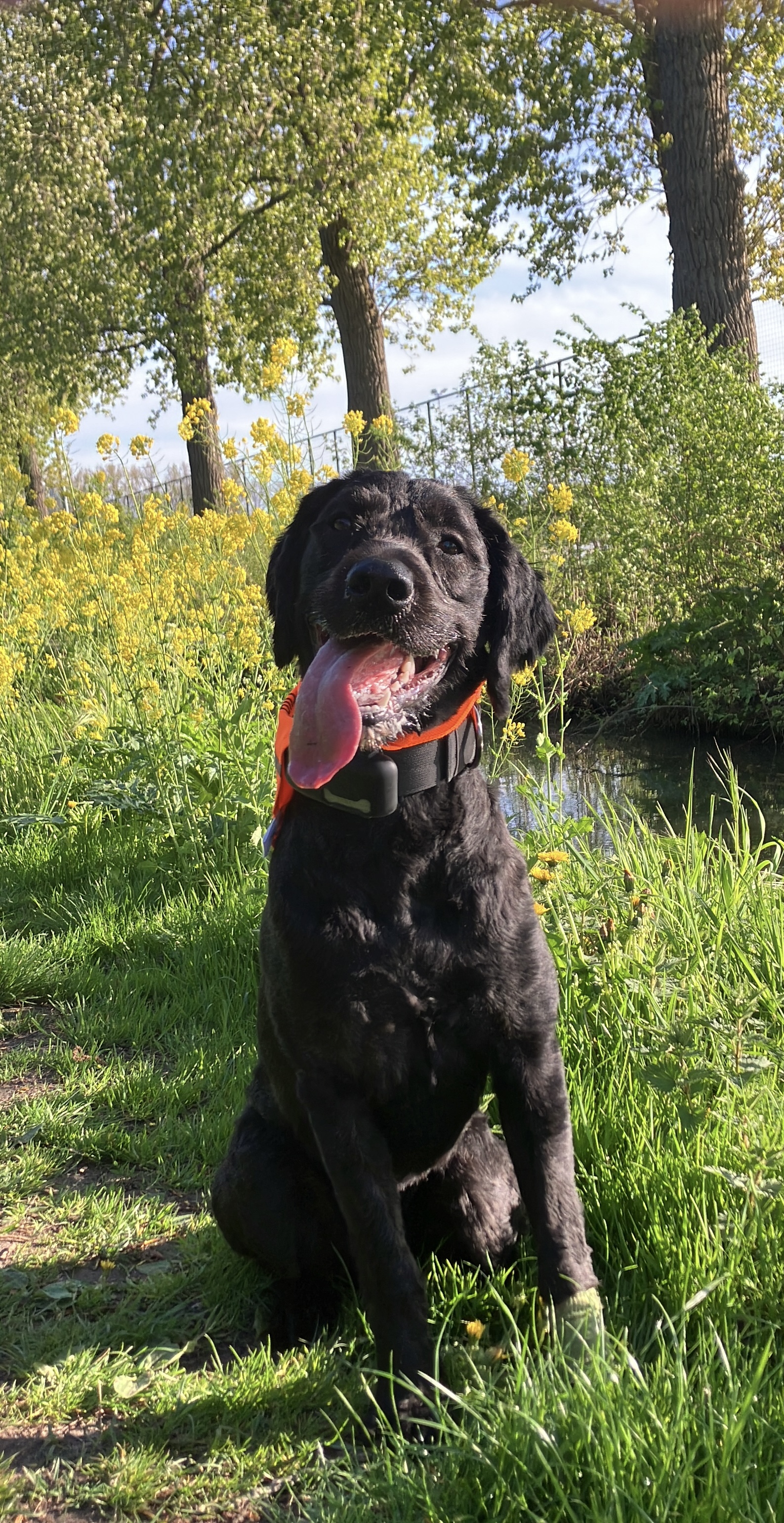
Foto's Dapnhe ter Beek
I do answer — I just choose the focus
This is important to say clearly: I am not avoiding questions.
I do answer. I simply choose what the answer is about.
Instead of talking about diagnoses or medical explanations,I talk about something that can be shared.
My dog.
Gently redirecting the conversation
If someone asks:“What kind of assistance dog do you have?”I often answer with the breed.
“She’s a Barberetriever.”
That is usually followed by:“A what?”
“A Golden Retriever crossed with a Barbet.”
And something shifts.
The conversation is no longer about what my dog does for me,but about what she looks like,where the breed comes from,whether she sheds,and what kind of dog she is.
The interaction becomes light. Normal. Human.
And my privacy stays intact.
“What does the dog do?” and “Why do you have that dog?”
These questions come up a lot too.
In practice, they often mean: What do you need this dog for?
And again, I choose a different angle.
Sometimes my answer is simply:
“Because she’s lovely.”
And then I talk about her personality.
About how she is:
gentle but not needy
sensitive
observant
calm, yet playful
I still answer the question. I am still engaged.
But I decide where the conversation goes.
Connection first, boundaries after
I am not distant.I make small talk. I am polite. I give attention.
And precisely because there has been human contact first, I can later say — if needed:
“Sorry, I’d rather not talk about that. It’s private.”
Not sharply.Not defensively.Just clearly.
For most people, that feels logical. They have been acknowledged.
Sometimes there simply isn’t space
Of course, there are days when I don’t have the time or energy.
Sometimes I am in a hurry. Sometimes my head is full. Sometimes I just need to keep moving.
Then I say, kindly but clearly:
“Sorry, I really need to go.”
“I don’t have time right now.”
“Not today, sorry.”
That is not rude. That is honest.
Visible signals that help without words
Sometimes I use visible aids:
a leash wrap saying “Do not approach”
a back patch
clear labels on lead, harness or bag
Often, simply pointing to them is enough.
Not confrontational. Not harsh. Just clear:today, I am not available for conversation.
“What’s the dog’s name?” — and why I don’t use the real one
Another very common question is:“What’s her name?”
It sounds friendly. And often it is.
But in reality, the name is usually asked in order to use it.
And I don’t want that while my dog is working.
My dog’s real name is Iris. But I rarely give that answer.
Instead, she might be called:
Petra
or another name
sometimes the name changes
I did the same with my previous assistance dog.
Why this works
When someone asks for the name and I give any name,that name has already been spoken out loud.
For most people, that satisfies the curiosity.The urge to use the name again usually disappears.
If I gave her real name, that name would be much more likely to be used again —to call her,to get her attention,to interact with her.
By giving a different name:
my dog stays out of the interaction
her focus remains protected
and I don’t have to correct anyone
It’s not secrency. It's practical.

Sometimes repetition is enough
Occasionally someone tries again:
“Oh right… what was her name again?Petra?”
I don’t explain. I don’t correct.
I simply say:
“Yes. Petra.”
And that’s enough.
Finding this difficult? Practise it
If you find this uncomfortable or difficult, that’s normal.
It helps to practise with someone you trust.
Ask them to repeat the common questions.Practise your answers.Use the same words each time.
That way, when the question comes unexpectedly,your answer is already there.
That brings calm.
It doesn’t have to be perfect — answering is a courtesy
And perhaps the most important thing to remember:
It does not have to be perfect.
They are asking something of you.Anything you share is a courtesy, not an obligation.
You don’t owe:
a detailed explanation
a well-phrased answer
a personal story
The fact that you respond at all,that you remain kind,that you take a moment —that is already something you give.

Why I try to keep things calm and respectful
In the end, most of us want the same thing:
simple, hassle-free access everywhere.
And I always keep one thought in mind:
After me, there will be other assistance dog teams.
How an interaction goes todayaffects how the next handler will be received.
That is why, when possible, I choose calm, clarity and respect. Not because my boundaries matter less,but because every interaction leaves something behind.
For me.For my dog. And for those who come after us.
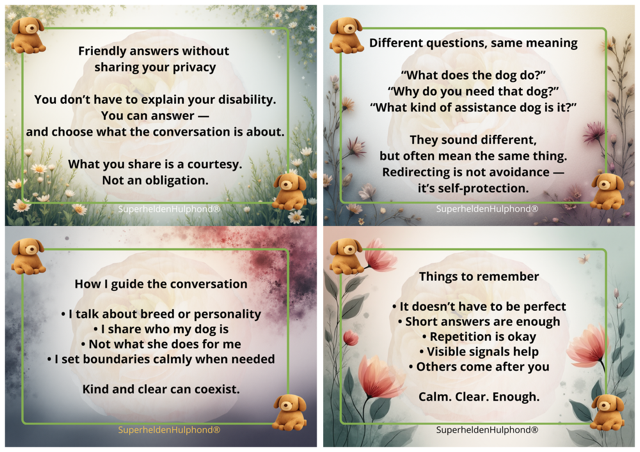
FREE download:
In short — what to remember
Many different questions often mean the same thing
You do answer — you just choose the focus
Talking about breed or personality protects your privacy
Boundaries can be kind and calm
Visible signals help without words
What you share is a courtesy, not a duty
Your actions today affect teams tomorrow
Kindness and self-protection can exist together.


Comments