.jpeg)

Iris, house dust mites and a long road to comfort
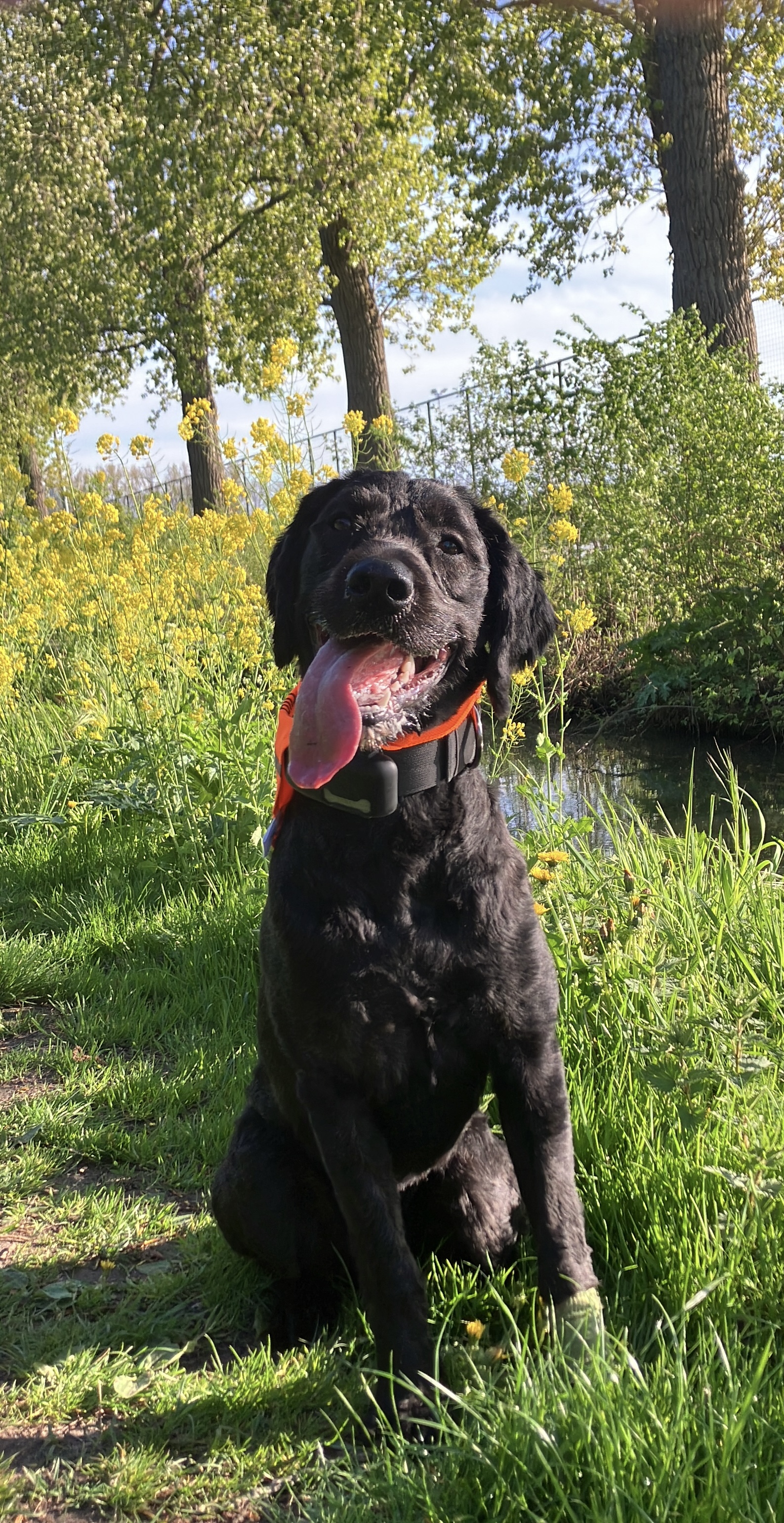
About allergy in dogs, desensitisation, tailored treatment – and the question of whether working with an allergy is fair
When Iris started scratching more and more often, her ears became more sensitive and her skin simply would not settle, I quickly felt: this is not a “just put some ointment on it” problem.
The pattern did not make sense. It kept coming back. And above all – it was clearly getting in her way.
For an assistance dog, that is not a small detail.
You cannot learn properly, work reliably and remain stable when your body is constantly irritated, itchy or painful.
In Iris’ case, house dust mites eventually turned out to play an important role.
And that is how we ended up in a trajectory that, beforehand, you rarely have a realistic picture of: desensitisation.
This is our story. With everything that comes with it – including the searching, the fine-tuning, the temporary support and the ethical questions that inevitably arise.
What is house dust mite allergy in dogs?
With a house dust mite allergy, a dog’s immune system reacts excessively to proteins from house dust mites.
Those allergens are everywhere:
in dog beds and blankets
in sofas and upholstery
in carpets
in rugs and soft toys
That immediately means something important:
👉 this allergy is usually not seasonal.
Symptoms are often present all year round.
What exactly is desensitisation?
Desensitisation (allergen immunotherapy) is not medication against itching.
It is training for the immune system.
The dog receives:
very small amounts of exactly those allergens
that cause symptoms in that individual dog
according to a fixed schedule via injections (sometimes via drops)
The goal is not a cure.
The goal is for the immune system to learn to respond less intensely.
What many people do not know: in dogs the dose remains the same
During the build-up phase, the dose is increased step by step.
But once the maintenance dose has been reached, that amount remains the same in dogs.
So you do not keep increasing the amount of allergen.
You keep repeating.
Not stimulating – but stabilising.
But… Iris is exposed to house dust mites all day anyway, isn’t she?
Yes. And that is exactly where confusion often arises.
Natural exposure:
takes place via the skin and mucous membranes
in areas where inflammation and hypersensitivity are already present
That exposure actually maintains the allergic pattern.
The injection is given:
in a controlled way
with a fixed, known dose
in a different immunological context
So the difference is not in how much allergen is involved,
but in how the immune system learns to deal with it.
Why does the effect fade when you skip a dose?
Because with desensitisation you do not build permanent insensitivity.
You build active tolerance.
And that tolerance needs to be maintained.
If you stop for too long, only natural exposure remains – and that does not train tolerance.
What does the standard protocol usually look like?
It is important to be honest about this.
Build-up phase
start with a very low dose
the dose is increased step by step
usually with intervals of several days to one week
This phase often lasts several weeks to several months.
Maintenance phase (standard)
once the final dose has been reached
the same dose is continued
usually one injection every 2 to 4 weeks
👉 This is the average starting point.
And then reality
Not every dog fits neatly into that schedule.
Iris certainly does not.
Our practice with Iris
In Iris’ case, the standard protocol proved insufficiently stable.
After a great deal of fine-tuning, she ended up on:
0.08 ml per injection – twice per week.
So:
a relatively small dose
but a higher frequency
And that specific combination gives her skin and ears relief and stability.
And yes – finding the right setting took months
Adjusting the correct dose and frequency for Iris
took more than six months.
It was not a straight line.
It was:
observing
adjusting
reviewing
adjusting again
Only after months did it become clear what worked for her body.
Her body shows the right moment itself
With Iris we clearly see:
more scratching
more restlessness in her skin
increased sensitivity
when the built-up tolerance starts to fade.
Not because she “decides” the dose,
but because her symptoms show how stable the tolerance is at that moment.
So the dog itself becomes an important measuring instrument.
And yes – in the beginning additional medication was needed
During the start-up phase, Iris temporarily needed support with anti-itch and anti-inflammatory medication.
At times she really scratched herself raw.
Unfortunately, that can happen at the start of this trajectory.
Desensitisation works slowly.
In that phase, the dog’s welfare always comes first.
Now that her schedule is stable, this is no longer necessary – and that is exactly why we are so satisfied with this approach.
Which other treatment options are commonly used for allergy?
Antihistamines
✔ relatively safe
✔ sometimes sufficient for mild symptoms
⚠ often limited effect
⚠ symptom-based treatment
Anti-inflammatory medication and prednisolone
✔ fast and powerful
✔ useful during severe flare-ups
⚠ clear side effects with long-term use
⚠ only suppress the reaction
Modern anti-itch / immune-modulating medication
✔ often effective
✔ usually fewer side effects than prednisolone
⚠ symptoms usually return after stopping
⚠ remain symptom-based
Supportive skin care and environmental adjustments
✔ important for comfort
✔ help to limit flare-ups
⚠ almost never sufficient as the only treatment
And desensitisation?
Advantages
targets the dysregulated immune response itself
works in a regulatory rather than suppressive way
suitable as a long-term strategy
often less dependence on ongoing anti-itch medication
Disadvantages
effect develops slowly
requires long-term commitment and monitoring
does not work in every dog
less suitable when there are many different allergies at the same time
additional support is often needed during the build-up phase
But before you can stabilise, you first need to know what triggers your dog
However carefully you want to work with desensitisation –
you can only start training the immune system once you know what it actually reacts to.
You first need an answer to a simple, but decisive question
What is my dog allergic to?
For Iris, that was also an essential starting point.
Not to create a list, but to be able to treat in a targeted way.
Desensitisation only works with allergens you actually know.
You cannot build tolerance for something that is not identified.
That is why, before we could start her desensitisation trajectory, we first carried out testing.
Not only for environmental allergens –
but also for food.
Precisely because itching, ear problems and skin reactions are often influenced by several factors at the same time.
For Iris, therefore, a food allergy blood test was performed in addition to the environmental allergy test.
Not because that test can prove everything, but to avoid overlooking anything and to narrow the field.
Only once we had a better picture of her main triggers could we start a trajectory that truly suited her.
Allergy testing – how did we do this?
In Iris’ case, a blood test for environmental allergens was performed.
This measures specific IgE antibodies against, among others:
house dust mites
storage mites
pollens
moulds
The results are used to compose a personalised immunotherapy preparation.
👉 This test is a tool, not a diagnosis on its own.
The dog’s clinical signs always remain leading.
And the food blood test?
We had that performed as well.
Such a test usually contains the most common food sources, such as:
beef
chicken
lamb
turkey
pork
fish
egg
grains and rice
Exotic proteins (such as ostrich or camel) are usually not included.
Such a test can:
✔ give direction
✔ help to select suspected ingredients
But:
⚠ it cannot reliably confirm a food allergy
⚠ and it cannot reliably rule it out
Mild food reactions and food intolerances are usually not visible in blood tests.
With severe food allergy, a reaction is seen more often – but even that is not guaranteed.
The only reliable way to assess food allergy remains:
a strict elimination diet with controlled re-introduction.
From test to a personalised product – and only then to self-injecting
Once it is clear what a dog reacts to, the process is not finished yet.
The desensitisation medication is custom-made for each dog based on the test results.
It is not a standard vial kept in stock, but a personalised allergen preparation.
In practice this means:
first formulation in the laboratory
then delivery
and only then can you start or continue your schedule
That takes time.
And that also means:
👉 you must always reorder well in advance.
Especially when – as in Iris’ case – the standard protocol is adjusted and injections are given more frequently.
At first, I found this quite stressful.
Not medically, but logistically.
Because this is not medication you can simply collect the same day.
Only once this whole process was running smoothly –
test → formulation → delivery → stable schedule –
did it become logical to take the next step:
not constantly going to the clinic,
but injecting in her own, calm environment.
I administer the injections myself
Before I started giving all injections at home, I first administered one myself in the clinic – under supervision.
So the veterinarian could see that:
I inject correctly
I work hygienically
and Iris accepts it calmly
Only after that did we start giving the injections structurally at home.
For Iris this means:
no constant visits to the clinic
no additional stress
a fixed and predictable moment in her own environment
For me this means:
control over her schedule
and being able to adjust quickly when her body indicates it is needed
For an assistance dog, that predictability is extremely important.
And why “Little Boss” is learning this too
Little Boss is not learning this in order to ‘help’.
He is learning this because it is realistic.
Because of my own health, it is possible that I may suddenly be admitted to hospital.
And at such a moment, someone must be able to take over Iris’ care safely and correctly.
Not only feeding and walking –
but also:
her medical care
her daily routine
and her desensitisation injections
We discussed this together first.
Whether he wanted to do this.
Whether he felt able to.
Whether he found it stressful.
And whatever his answer would have been – that would have been decisive for me.
I do not care how long it takes him to learn this.
What matters to me is that there is someone who knows:
what Iris receives
why she receives it
and what happens if a dose is missed
Otherwise, every time I am unexpectedly hospitalised, Iris would have to go to the clinic twice a week for an injection.
That would mean:
extra stress for her
losing her routine
and more strain for a dog who actually needs stability
This is not an emergency solution.
This is consciously thinking about continuity of care.
Is it ethically responsible to let a dog with an allergy work?
For me, the answer does not lie in the word allergy.
It lies in:
how well the symptoms are controlled
how much discomfort the dog actually experiences
how much medical intervention is required
and how stable the dog can function
A dog with an allergy who:
constantly itches
regularly develops inflammation
repeatedly needs time to recover
and can only function with heavy suppressive medication
has, in my view, a serious welfare problem.
But a dog with an allergy who:
is stably managed
has hardly any symptoms
is comfortable in her body
and does not have to push beyond her limits
can – with good guidance – work responsibly.
For Iris, my core question was not:
“Can she still perform her tasks?”
but:
“Is she comfortable in her body?”
Only when that question could genuinely be answered with yes did it feel ethically right to me.
With assistance dogs, the bar should always be higher than merely functioning.
In conclusion
Desensitisation is not an easy path.
It requires:
time
observation
fine-tuning
patience
and realistic expectations
But when the most important allergens have been properly identified and the number of triggers remains manageable, this is one of the few treatments that truly aims to address the problem at its source.
Internationally, allergen immunotherapy is also regarded as an important long-term treatment for environmental allergies in dogs, among others within the guidelines of the
World Small Animal Veterinary Association.
For us – and for Iris – this path ultimately provided something that may be the most important thing for an assistance dog:
comfort in her body.


Comments